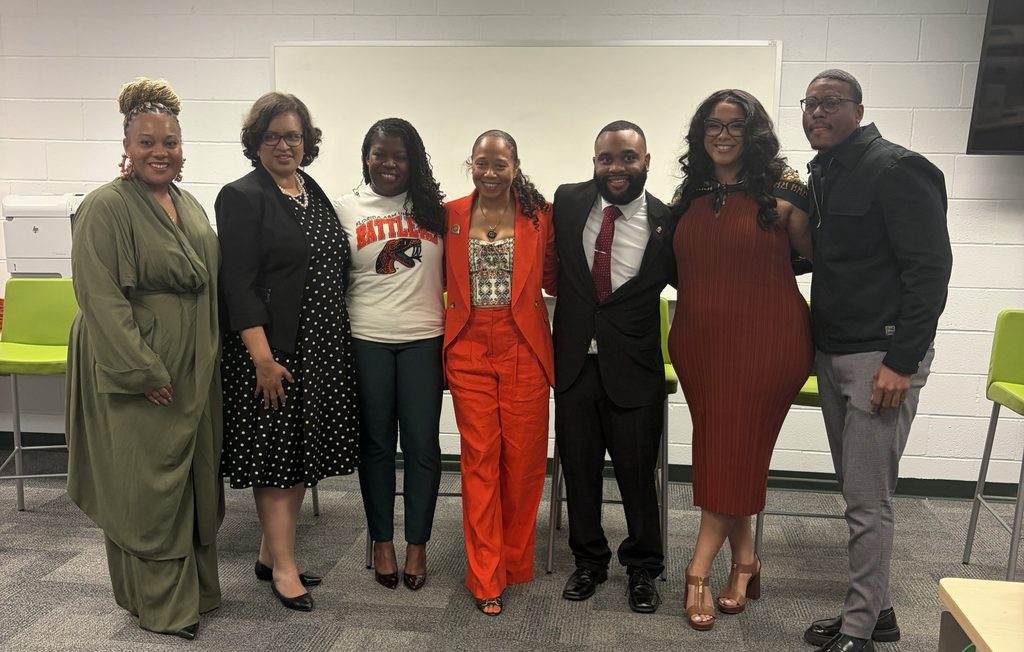

Arnika Jackson, Carole Sykes, Shayla Cannady, Tamara Blount, Ferrisa Connell, Calvin Sykes, and Navael Fontus stand together to take a photo after ‘Proceeding Through the Pivot’ panel (Myrthel Michel / FAMUAN)
Florida A&M University journalism alumni returned to campus Thursday, Oct. 22 with advice for students preparing to enter the workforce.
“Remember that a pivot does not mean starting over,” said Carole Sykes, a 1991 FAMU graduate and moderator of the Grads Are Back panel “Proceeding Through the Pivot.”
The discussions, “Proceeding Through the Pivot” and “Change Makers: Own Your Voice, Chart Your Trajectory,” featured alumni working in fields such as public relations, government, marketing and nonprofit leadership, who shared lessons on navigating workplace challenges, making difficult career decisions and applying their journalism skills across industries.
For Lila Bleu Bell, a 2020 FAMU graduate and strategic communications professional, finding her voice meant challenging a client’s decision early in her career.
Shortly after George Floyd’s murder in 2020, Bell was working at a public relations firm when a law enforcement client requested to participate in a social media trend showing solidarity with the Black Lives Matter movement.
“Something about this feels wrong,” Bell recalled thinking.
Despite being a recent graduate and one of only two Black employees at the firm, Bell emailed her team explaining why she believed the post was inappropriate.
“I was just hired. I was very young, like, fresh out of undergrad, so it was a little scary,” Bell said.
Rather than dismissing her concerns, leadership thanked her for speaking up and decided against publishing the post.
“Thank you for flagging this. Thank you for not being on autopilot and just doing what you were told. Thank you for pushing back,” Bell said her leadership told her.
“Even if nobody in the room looks like you, even if nobody in the room comes from where you come from, that is why your perspective matters and why diversity is so important,” Bell said.
Her experience reflected a recurring message throughout the afternoon: young professionals should not underestimate the perspectives they bring to the workplace.
Melanie Newman, a 2001 FAMU graduate and chief external affairs officer at the Planned Parenthood Federation of America, emphasized the importance of honesty in communications.
“You can’t do your job if you don’t tell them the truth,” Newman said.
She connected that responsibility to her journalism training and experiences working in government communications, where providing honest advice to leadership was essential.
Heidi Otway, moderator of the Change Makers panel, also challenged students to contribute their perspectives rather than remain silent in professional settings.
“Because when you’re silent, I don’t need you in the room,” Otway said.
While the Change Makers panel focused on professional confidence and personal values, the earlier Proceeding Through the Pivot discussion explored how journalism graduates can apply their skills outside traditional media careers.
Panelists represented industries ranging from urban planning and education to nonprofit management and community engagement.
Tamara Blount, a 1997 FAMU graduate and regional communications manager for the American Red Cross, described how her journalism education prepared her to work under pressure, meet deadlines and communicate with people experiencing difficult circumstances.
Her career has included communications positions with the Federal Emergency Management Agency, the Department of Homeland Security and the Centers for Disease Control and Prevention.
Other alumni described similar experiences, emphasizing that skills developed in journalism school can create opportunities in industries students may not initially consider.
Arnika Frazier-Jackson, director of student professional development programs at UNCF, recalled changing career directions several times before finding her place in nonprofit work supporting historically Black colleges and universities.
“For me, it’s what centers me, my moral compass,” Frazier-Jackson said.
She told students that her values have guided her decisions since leaving a position on Capitol Hill.
“I made a decision a long time ago, actually, when I left off of Capitol Hill here in D.C., that I would never take a job that would have me to compromise what my goals and values are,” she said.
Frazier-Jackson also cautioned students against allowing financial considerations to determine every professional decision.
“When you are a prisoner to a paycheck, then you are a prisoner to whatever it is that that company or individual wants you to do,” she said.
The conversations also addressed the emotional challenges of changing careers and the importance of maintaining personal well-being.
During the Pivot panel, Shayla Cannady, chief communications officer at Chiefs for Change, described accepting a leadership position in Charlotte, North Carolina, after her husband’s death in 2021.
Cannady discussed the sacrifices involved in pursuing the opportunity while caring for her young son and adjusting to a new chapter in her personal life.
Other panelists described leaving demanding workplaces after experiencing burnout, health concerns or environments that no longer supported their professional growth.
Newman echoed those concerns during the Change Makers panel, reflecting on the pressures of leading communications through political challenges and organizational changes.
After years of managing high-stress responsibilities, she said she learned to establish boundaries and prioritize her health and family.
“This job is not gonna kill me,” Newman said.
Both discussions also highlighted the importance of building relationships, seeking mentors and remaining open to unexpected opportunities.
Frazier-Jackson encouraged students to continue learning and develop a network of people who could provide professional guidance throughout their careers.
“Be intentional about your relationships, about your studies, about how you live your life, who you are as a person,” Sykes said. “Don’t let your voice or your path be diminished by no one.”