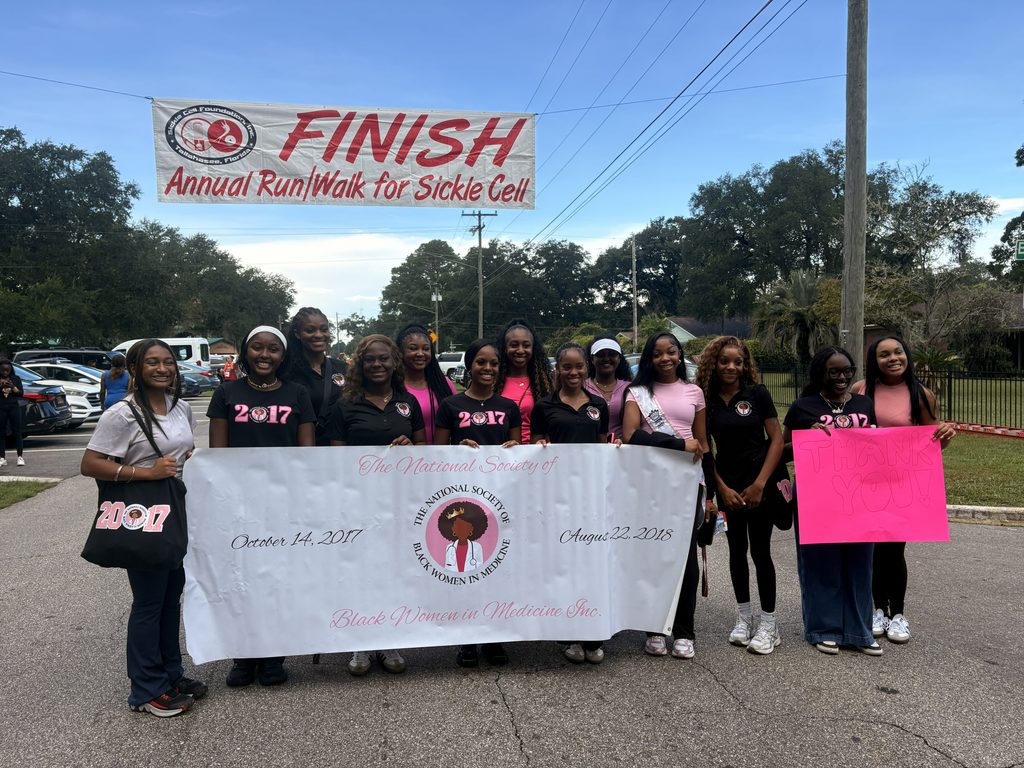

FAMU’s National Society of Black Women in Medicine volunteering at the 45th Annual Run/Walk for Sickle Cell hosted by the Sickle Cell Foundation and the Gulf Winds Track Club. (Provided By / FAMU National Society of Black Women in Medicine)
As National Sickle Cell Awareness Month concludes, Tallahassee students, sickle cell warriors and healthcare volunteers advocate for clinical validation, medical education and patient support to be permanent, year-round priorities for providing sickle cell awareness.
According to the Centers for Disease Control and Prevention, Sickle cell disease affects more than 100,000 Americans and 90% of US sickle cell patients identify as non-Hispanic Black or African American.
According to a report from the National Institutes of Health, “about 1 in 13 Black babies are born with sickle cell trait, and about 1 in every 365 Black babies are born with sickle cell disease.”
Despite the severity of the disease, sickle cell warriors often encounter medical bias and dismissal from individuals who do not understand an “invisible” illness.
“The biggest misconception is when people say, ‘Your pain is not that bad,’ or ‘You can take it.’ Growing up, I heard that a lot,” said Janiya Penny, 22-year-old sickle cell warrior and creator of the Instagram page, Prettypennygirlsco.
Penny, who uses her Instagram to foster safe spaces for young women managing sickle cell, recalled educators dismissing severe pain during her childhood.
“Even in school with teachers, I could go into a crisis during class. We probably just came from recess; my legs would start hurting and I’d tell my teacher. They would say, ‘Nothing is wrong with you. Go sit down.’ It makes life a lot harder for sickle cell patients, especially when being vulnerable, because now you’re telling me I’m faking my pain or it’s not real. How am I supposed to be vulnerable if I can’t even tell someone I’m in pain? That’s the biggest thing I wish people would throw out the window.”
Turning that vulnerability into support and advocacy is the primary focus for local organizations.
Carissa Hunter, director of communications for the Sickle Cell Foundation of Tallahassee, emphasizes the goal of spreading awareness is to motivate the community to show up.
“When I see the community show up, I see it from both perspectives. Professionally, I understand the importance of advocacy and education.” Hunter said, “But as a mother [of a child living with sickle cell], there’s something very different about seeing people who don’t necessarily have sickle cell, but they choose to learn and choose to show up for other families like my own.”
That spirit of collective care was on full display at the 45th Annual Sickle Cell 5K in Tallahassee, where many residents, student organizations and local leaders gathered.

Members of Alpha Kappa Alpha Sorority Inc. cheering on running participants (Provided By / Alpha Kappa Alpha Sorority Inc.)
“Sickle cell is very important and very dominant in the Black community, so anything to help with research or awareness, I will definitely do,” said Laila Wilson, a Tallahassee local and repeat participant in the annual 5K. “It’s nice to see community members come together for a cause, including sororities, other organizations, and familiar faces. Former mayoral candidate Daryl Parks was out there doing the 5K as well.”
“I love being able to serve my community in any capacity, so it truly was a wonderful experience. I would recommend this to everyone, and I would definitely come again when it’s hosted next year,” said I’myani Key, who volunteered at the event representing FAMU’s National Society of Black Women in Medicine, where she serves as secretary.
For Hunter, community events and ongoing support represent a lifeline against the stigmatization of sickle cell disease.
“Sickle cell awareness is more than just knowing the name of the disease, a blood disorder, it’s choosing to understand people and families affected by it,” Hunter said. “You don’t have to live with sickle cell to be part of our community, just showing up really, really matters.”